
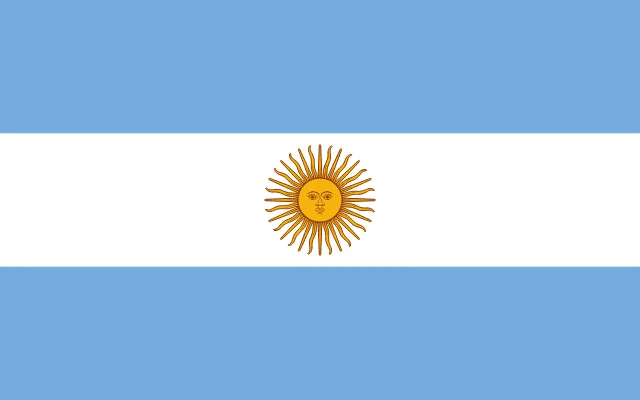
Argentina National Anthem — Himno Nacional Argentino
The "Himno Nacional Argentino" is the national anthem of Argentina, adopted on 11 May 1813 — three years after the May Revolution and before Argentina had formally declared independence. Its words are by Vicente López y Planes and its music by the Catalan-born Blas Parera. The commonly sung version pairs the opening quatrain — "Oíd, mortales, el grito sagrado" ("Hear, mortals, the sacred cry") — with the stirring coda "Sean eternos los laureles". This page gathers the anthem's Spanish lyrics, English translation, meaning and history.
Himno Nacional Argentino Spanish Lyrics
Original (Spanish) version
Oíd, mortales, el grito sagrado:¡Libertad, libertad, libertad!
Oíd el ruido de rotas cadenas,
ved en trono a la noble igualdad.
Sean eternos los laureles
que supimos conseguir.
Coronados de gloria vivamos,
¡o juremos con gloria morir!
English Translation version
Hear, mortals, the sacred cry:Freedom, freedom, freedom!
Hear the sound of broken chains,
see noble equality enthroned.
May the laurels be eternal
that we knew how to win.
Let us live crowned with glory,
or swear to die with glory!
Public domain — lyrics by Vicente López y Planes, music by Blas Parera (1813).
Lyrics licensed via Public Domain.
Song Details
- Singer
- Argentina
- Lyricist
- Vicente López y Planes
- Music
- Blas Parera
- Genre
- National Anthem
- Released
- May 11, 1813
- Language
- Spanish
- Views
- 551
💭 Meaning of "Himno Nacional Argentino" Song Lyrics
The anthem was born of revolution. Its opening — "Oíd, mortales, el grito sagrado: ¡Libertad, libertad, libertad!" ("Hear, mortals, the sacred cry: Freedom, freedom, freedom!") — proclaims the fall of colonial rule, with the "sound of broken chains" and "noble equality" enthroned in place of the old order.
The famous coda, "Sean eternos los laureles que supimos conseguir" ("May the laurels we won be eternal"), turns from triumph to resolve: to live "crowned with glory" or to "swear to die with glory". Together they capture the spirit of the independence struggle in the River Plate.
🎬 Behind the song: how "Himno Nacional Argentino" was made
The lyrics were written by the poet Vicente López y Planes and set to music by the Catalan-born composer Blas Parera. The General Constituent Assembly (the "Assembly of the Year XIII") adopted the song on 11 May 1813, during the wars of independence. The original poem was long and fiercely anti-Spanish; in 1900, once Spain was an ally, a decree established that only the first quatrain and the final coda be performed on public occasions — the version still sung today.
🌍 "Himno Nacional Argentino" — Cultural impact & legacy
Argentina celebrates 11 May as "Día del Himno Nacional Argentino" (National Anthem Day). As one of the earliest anthems in the Americas, it is a powerful symbol of the country's founding, sung at schools, state ceremonies and, with great fervour, before Argentina's football matches.
📖 What is "Himno Nacional Argentino Song Lyrics" about?
The "Himno Nacional Argentino" is the national anthem of Argentina, one of the oldest of the Americas' national anthems. The lyrics are by Vicente López y Planes and the music by Blas Parera, both from 1813.
It was adopted by the Assembly of the Year XIII on 11 May 1813. The full original poem is long; the version sung today uses the first quatrain and the final coda. Words and music are in the public domain.
⭐ Behind the song trivia
- It was adopted on 11 May 1813, three years before Argentina formally declared independence.
- The original poem was long and strongly anti-Spanish; in 1900 a decree limited public performances to the first quatrain and the coda.
- The music was written by Blas Parera, a composer born in Catalonia, Spain.
- Lyricist Vicente López y Planes later briefly served as president of Argentina.
- Argentina marks 11 May each year as "National Anthem Day".
- It is one of the oldest national anthems in the Americas.
❓ Himno Nacional Argentino — Frequently asked questions
What is the national anthem of Argentina?
What does the Argentine anthem mean?
Why is only part of the Argentine anthem sung?
Who wrote the Argentine national anthem?
When was the Argentine anthem adopted?
How old is the Argentine national anthem?
👥 Credits
| Vocals | Argentina |
|---|---|
| Lyricist | Vicente López y Planes |
| Music Director | Blas Parera |
📄 Copyright disclaimer
All lyrics, images, and audio/video featured on LyricsSol.com are the intellectual property of their respective copyright owners. We do not claim ownership of any lyrics, music, or related media.
Lyrics are provided solely for educational, reference, and personal use under the doctrine of fair use. No copyright infringement is intended.
If you are the rightful copyright holder and would like any content to be removed or credited differently, please contact us through our Contact Page for prompt action.
Comments 0
No comments yet. Be the first to share your thoughts!