
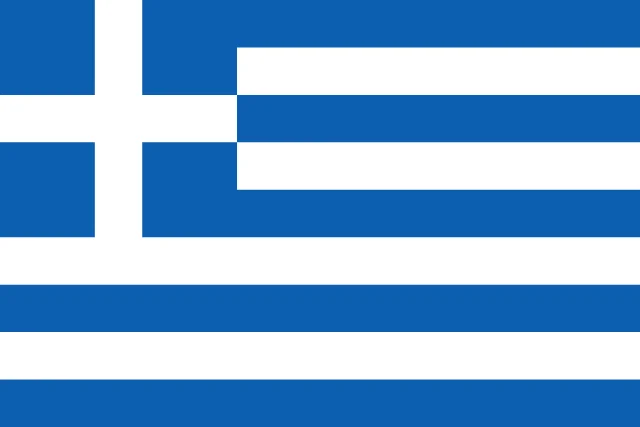
Greece National Anthem — Hymn to Liberty
The "Hymn to Liberty" (Ýmnos is tin Eleftherían) is the national anthem of Greece and, uniquely, also of Cyprus. Its words come from a vast 158-stanza poem written by Dionysios Solomos in 1823, during the Greek War of Independence; only the first two stanzas are sung as the anthem. Nikolaos Mantzaros set it to music in 1828, and Greece adopted it in 1865. Addressing Liberty as a living figure "risen from the sacred bones of the Greeks", it is a passionate salute to freedom. This page gathers the anthem's Greek lyrics, English translation, meaning and history.
Hymn to Liberty Greek Lyrics
Original (Greek) version
Σε γνωρίζω από την κόψητου σπαθιού την τρομερή,
σε γνωρίζω από την όψη
που με βία μετράει τη γη.
Απ' τα κόκκαλα βγαλμένη
των Ελλήνων τα ιερά,
και σαν πρώτα ανδρειωμένη,
χαίρε, ω χαίρε, Ελευθεριά!
English Translation version
I recognise you by the fearsomeedge of your sword,
I recognise you by the gaze
that surveys the earth with force.
Risen from the sacred
bones of the Greeks,
and valiant as of old,
hail, oh hail, Liberty!
Public domain — poem by Dionysios Solomos (1823), music by Nikolaos Mantzaros (1828).
Lyrics licensed via Public Domain.
Song Details
- Singer
- Greece
- Lyricist
- Dionysios Solomos
- Music
- Nikolaos Mantzaros
- Genre
- National Anthem
- Released
- Aug 04, 1865
- Language
- Greek
- Views
- 191
💭 Meaning of "Hymn to Liberty" Song Lyrics
The "Hymn to Liberty" addresses Freedom directly, as though she were a living heroine. The famous opening — "I recognise you by the fearsome edge of your sword" — pictures Liberty by the sword that won her and the piercing gaze with which she measures the world.
The second stanza declares her "risen from the sacred bones of the Greeks" and "valiant as of old", greeting her with the cry "hail, oh hail, Liberty!". Written during the war against Ottoman rule, it fuses the memory of ancient Greece with the newborn freedom of the 1820s revolution.
🎬 Behind the song: how "Hymn to Liberty" was made
Dionysios Solomos, regarded as Greece's national poet, wrote the 158-stanza "Ýmnos is tin Eleftherían" in 1823 on the island of Zakynthos, at the height of the Greek War of Independence. The composer Nikolaos Mantzaros set it to music in 1828. In 1865 King George I made the first two stanzas, with Mantzaros's setting, the official national anthem of Greece; Cyprus later adopted the same anthem.
🌍 "Hymn to Liberty" — Cultural impact & legacy
Solomos and his hymn are cornerstones of modern Greek identity, and the poet and his opening lines have appeared on Greek coins and banknotes. The "Hymn to Liberty" is the only anthem shared by two independent nations, Greece and Cyprus, and its full poem is often cited as the longest national-anthem text in the world.
📖 What is "Hymn to Liberty Song Lyrics" about?
The "Hymn to Liberty" is the national anthem of Greece — and also of Cyprus — one of the most storied of the world's national anthems. The poem is by Dionysios Solomos (1823) and the music by Nikolaos Mantzaros (1828).
Greece adopted it in 1865. The complete poem runs to 158 stanzas, of which the anthem uses the first two. Both text and music are in the public domain.
⭐ Behind the song trivia
- The full poem by Dionysios Solomos has 158 stanzas, making it by that measure the longest national anthem text in the world — only the first two are sung.
- It is the national anthem of both Greece and Cyprus, the only anthem shared by two sovereign states.
- The poem was written in 1823, during the Greek War of Independence against Ottoman rule.
- It addresses Liberty directly, as a living figure "risen from the sacred bones of the Greeks".
- Poet Dionysios Solomos is regarded as Greece's national poet; his image and words have appeared on Greek currency.
- It was adopted as Greece's national anthem in 1865, with music by Nikolaos Mantzaros.
❓ Hymn to Liberty — Frequently asked questions
What is the national anthem of Greece?
What does the Hymn to Liberty mean?
Is the Hymn to Liberty really the longest anthem?
Do Greece and Cyprus share the same anthem?
Who wrote the Greek national anthem?
When was the Hymn to Liberty adopted?
👥 Credits
| Vocals | Greece |
|---|---|
| Lyricist | Dionysios Solomos |
| Music Director | Nikolaos Mantzaros |
📄 Copyright disclaimer
All lyrics, images, and audio/video featured on LyricsSol.com are the intellectual property of their respective copyright owners. We do not claim ownership of any lyrics, music, or related media.
Lyrics are provided solely for educational, reference, and personal use under the doctrine of fair use. No copyright infringement is intended.
If you are the rightful copyright holder and would like any content to be removed or credited differently, please contact us through our Contact Page for prompt action.
Comments 0
No comments yet. Be the first to share your thoughts!