
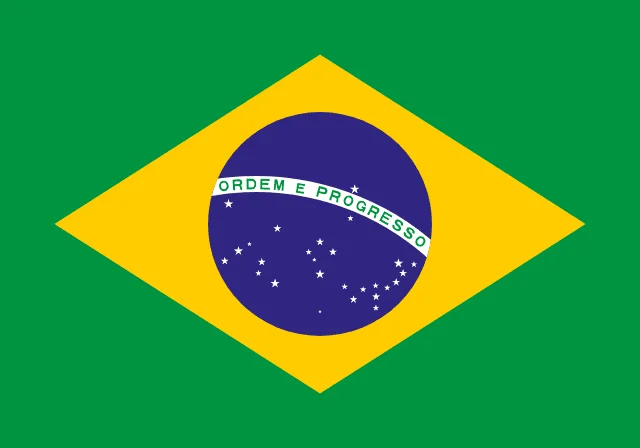
Brazil National Anthem — Hino Nacional Brasileiro
The "Hino Nacional Brasileiro" is the national anthem of Brazil. Its stately melody was composed by Francisco Manuel da Silva in 1831, and the poem now sung as its lyrics — by Joaquim Osório Duque-Estrada — was officially adopted in 1922. Famously ornate and difficult to sing, the anthem opens on the banks of the Ipiranga, where Brazilian independence was declared, and unfolds as a lush, patriotic celebration of the homeland and its liberty. This page gathers the anthem's Portuguese lyrics, English translation, meaning and history.
Hino Nacional Brasileiro Portuguese Lyrics
Original (Portuguese) version
Ouviram do Ipiranga as margens plácidasDe um povo heroico o brado retumbante,
E o sol da liberdade, em raios fúlgidos,
Brilhou no céu da pátria nesse instante.
Se o penhor dessa igualdade
Conseguimos conquistar com braço forte,
Em teu seio, ó liberdade,
Desafia o nosso peito a própria morte!
English Translation version
The placid banks of the Ipiranga heardthe resounding cry of a heroic people,
and the sun of liberty in shining rays
shone in the homeland's sky at that moment.
If the pledge of this equality
we managed to conquer with a strong arm,
in thy bosom, O freedom,
our chest defies even death itself!
Public domain — music by Francisco Manuel da Silva (1831), lyrics by Duque-Estrada (1909).
Lyrics licensed via Public Domain.
Song Details
- Singer
- Brazil
- Lyricist
- Joaquim Osório Duque-Estrada
- Music
- Francisco Manuel da Silva
- Genre
- National Anthem
- Released
- Sep 06, 1922
- Language
- Portuguese
- Views
- 133
💭 Meaning of "Hino Nacional Brasileiro" Song Lyrics
The anthem opens with a vivid historical image: the "placid banks of the Ipiranga" hearing the "resounding cry of a heroic people" — a reference to the moment in 1822 when independence from Portugal was proclaimed beside that stream. From there it becomes a hymn to liberty won by a "strong arm".
Duque-Estrada's poem is famously ornate, layering grand, sometimes archaic imagery of the sun of freedom, the beloved homeland and a people ready to defy death for their independence. It is less a call to arms than a proud, romantic portrait of the nation and the ideals it was founded on.
🎬 Behind the song: how "Hino Nacional Brasileiro" was made
Francisco Manuel da Silva composed the melody in 1831, and it served as an unofficial patriotic tune for decades. Duque-Estrada wrote his poem in 1909, and a lightly adapted version was formally adopted as the anthem's lyrics by presidential decree in 1922, during the centenary of independence. A full performance covers two long stanzas.
🌍 "Hino Nacional Brasileiro" — Cultural impact & legacy
The Brazilian anthem is renowned as one of the most musically demanding in the world, with a sweeping range and dense, poetic text that many Brazilians know by heart. It is a fixture at football matches, where crowds famously continue singing a cappella after the music stops.
📖 What is "Hino Nacional Brasileiro Song Lyrics" about?
The "Hino Nacional Brasileiro" (Brazilian National Anthem) is the national anthem of Brazil, one of the world's national anthems. Its melody dates to 1831; the current lyrics, a poem by Joaquim Osório Duque-Estrada, were made official in 1922.
Both music and words are long out of copyright and in the public domain. The anthem is known for its rich, elaborate language and wide melodic range.
⭐ Behind the song trivia
- The melody was composed by Francisco Manuel da Silva in 1831, decades before the words were adopted in 1922.
- The lyrics, a poem by Joaquim Osório Duque-Estrada (1909), were made official during the centenary of Brazilian independence.
- It opens on the banks of the Ipiranga stream, where independence from Portugal was proclaimed in 1822.
- It is considered one of the most musically demanding anthems, with a very wide range and rapid, ornate lyrics.
- The poem uses erudite, archaic Portuguese, including the famous phrase "gigante pela própria natureza" (a giant by its own nature).
- At football matches, Brazilian crowds famously keep singing the anthem a cappella after the band stops playing.
❓ Hino Nacional Brasileiro — Frequently asked questions
What is the national anthem of Brazil?
What does the Brazilian anthem mean?
Who wrote the Brazilian national anthem?
Why is the Brazilian anthem so hard to sing?
How long is the Brazilian national anthem?
Why do Brazilian fans sing it after the music stops?
👥 Credits
| Vocals | Brazil |
|---|---|
| Lyricist | Joaquim Osório Duque-Estrada |
| Music Director | Francisco Manuel da Silva |
📄 Copyright disclaimer
All lyrics, images, and audio/video featured on LyricsSol.com are the intellectual property of their respective copyright owners. We do not claim ownership of any lyrics, music, or related media.
Lyrics are provided solely for educational, reference, and personal use under the doctrine of fair use. No copyright infringement is intended.
If you are the rightful copyright holder and would like any content to be removed or credited differently, please contact us through our Contact Page for prompt action.
Comments 0
No comments yet. Be the first to share your thoughts!